
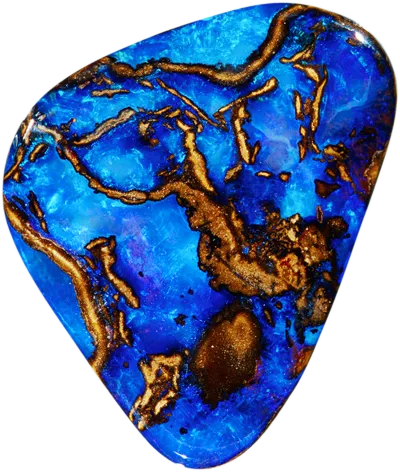
Opal is a massively popular gemstone and is also the birthstone for the month of October. Precious opal can flash every color of the spectrum with color intensity and quality which can best a diamond. As such, the highest quality opals can even command prices per carat that rivals that of the diamond.
Predominantly found in Australia, Opal is one of only six types of precious gemstones found on planet earth, sharing rarified air with the likes of diamonds, rubies, sapphires, emeralds, and pearls.
Be Careful: Opal Is Gorgeous On Your Jewelry But It Can Also Be Very Fragile
Opal is softer and can chip much more easily than other popular gemstones.
We actually have a rating for hardness called the Mohs hardness scale. Without getting too technical about it, Opal has a hardness of about 5.5 to 6.0. For context, the diamond has a rating of 10.
It is so much more brittle because Opal contains water - whereas many other gemstones do not.
The most optimal settings for Opal are as a stone for earrings, pendants, and brooches. These items are either not worn on an everyday basis, or receive very little of the day-to-day wear and tear of other items like necklaces or rings.
Even when worn in their optimal settings, it is best to still remove your Opal during activities when impact or abrasion might occur – even if it is set lower than other gemstones.
Is Opal Formed In The Same Manner As Other Precious Gemstones Like Diamonds?
Ironically enough, water makes Opal brittle, but is also what makes Opal so beautiful.
Opal is formed from a solution of silicon dioxide and water. That is to say, water seeps through sandstone and it picks up tiny particles of silica as it moves through the sandstone. As Opal was forming millions of years ago, the solution flowed into cracks and voids in sedimentary as well as volcanic areas
Because it remained in these areas, the Opal could stay soft and uncemented for long periods before becoming hardened. In turn, some Opal also has an internal structure that consists of regularly packed spheres, which enables it to treat light similar to how a prism would treat light. This phenomenon is known as "play-of-color".
Let's Discuss The Stark Difference Between "Common Opal" and "Precious Opal"
Most Opal is "Common Opal" or Opal which does not have the colorful prism-like qualities we already established as "play-of-color". Common Opal is also referred to as “potch” by many industry people as well.
Since most “Common Opal” has an unremarkable appearance, they are almost invariably overlooked in the wide fields of gemstones. There are, however, some specimens of “Common Opal” which can be very attractive and colorful when cut into gemstones and highly polished. But any reputable jeweler would very easily be able to discern “Common Opal” from “Precious Opal” because the “Common Opal” simply lacks the play of color which would earn it the name "precious."
"Precious Opal" flashes iridescent colors when it is viewed from different angles, when the stone is moved, or when the light source is moved - and that flash is exactly the play of color.
“Precious Opal” can flash a number of colors such as bright yellow, orange, green, blue, red, or purple, and the brilliance of these colors determines the quality of the play of color.
As such, “Precious Opals” desirability is based upon the play of color intensity, diversity, uniformity, pattern, and ability to be seen from any angle.
If you examine a specimen of “Precious Opal” under bright light, play-of-color can be observed in three situations: 1. When the stone is moved. 2. When the light source is moved. 3. When the angle of observation is changed.
How To Tell If Your Opal Is A Solid Opal, An Opal Doublet, Or A Opal Triplet
SOLID OPAL: Most cut opals are solid stones. In this case, the entire stone is cut from a single piece of rough stone. Though there are instances of some rough Opal having very thin but brilliant layers of play-of-color material.
OPAL DOUBLET: Some artisans cut the stone down to the thin color layer and glue it to a base of obsidian, potch, basalt, or plastic - then cut a finished stone. So it looks like the Opal has two layers.
OPAL TRIPLET: To protect the fragile Opal from breaking or scratching, many artisans glue a transparent cap of quartz, spinel, or other transparent material onto the Opal. This process produces a three-part stone, called an "opal triplet" – which can be applied in a variety of different settings and ways for consumer use.
Is It Possible That Your Opal is Either Synthetic or An Imitation?
To put it plainly, yes, it is very possible.
Sometimes referred to as “Opal Essence”, “Opalite” or “Aurora Opals”, imitation opals are beautiful and legitimate products if they are sold with clear disclosure from the seller.
Whatever their name, imitation opals have been made since the 1960s and are becoming more common in the gem and jewelry market. Many people enjoy their appearance and appreciate the lower cost while retaining a similar effect to real Opal.
In fact, Imitation Opal appearance is becoming harder to distinguish from natural Opal and can sometimes fool even an experienced gemologist if they are well made. Though, a smart gemologist will send any specimen to a lab for further review if there is any slight doubt over the Opal’s genuine makeup.